
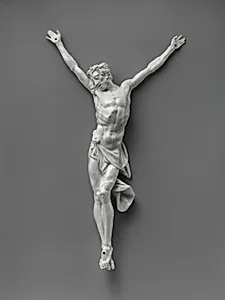
Corpus from a Crucifix
Medium
Hard-paste porcelain
Dimensions
Overall (confirmed): 13 3/8 x 8 5/16 x 1 3/4 in. (34 x 21.1 x 4.4 cm); Other (cross): 18 7/8 in. (47.9cm)
Classification
Ceramics-Porcelain
Culture
German, Nymphenburg
Department
European Sculpture and Decorative Arts
Museum
Metropolitan Museum of Art, New York, NY
Credit
Bequest of R. Thornton Wilson, in memory of his wife, Florence Ellsworth Wilson, 1977
Accession Number
1977.216.56
Rights
Public Domain
Tags
Art Historical Context
This exquisite *Corpus from a Crucifix*, crafted around 1755 by Franz Anton Bustelli the Nymphenburgcelain Manufactory, the pinnacle of 18th-century German porcelain. Measuring 13⅜ x 8¼ x 1¾ inches, the hard-paste porcelain figure depicts the body of Christ in a moment of profound suffering, originally designed to attach to a cross (now separately 18⅞ inches tall). Bustelli, a master sculptor at Bavaria's renowned Nymphenburg factory, was celebrated for his ability to capture lifelike emotion and delicate anatomy in fragile porcelain, rivaling the era's finest marble or ivory works. Nymphenburg, established in 1747 under Bavarian electoral patronage, became a hub of Rococo innovation, producing luxury ceramics that blended technical virtuosity with theatrical grace. Hard-paste porcelain—fired at high temperatures for exceptional durability and translucency—allowed Bustelli to achieve intricate details like the subtle veins, flowing loincloth, and anguished expression, techniques that pushed the medium's limits during Europe's "white gold" craze. A poignant symbol of Catholic devotion in Baroque-Rococo Germany, this piece reflects the era's fusion of faith and opulence. Bequeathed to the Metropolitan Museum of Art in 1977 by R. Thornton Wilson in memory of his wife, it invites visitors to marvel at porcelain's transformative power, turning everyday material into sacred poetry.