
Corset
c. 1941
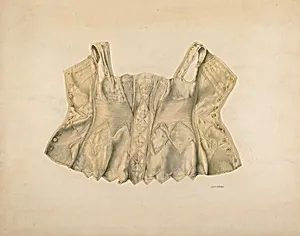
Medium
watercolor, graphite, and colored pencil on paper
Dimensions
overall: 45.7 x 57.8 cm (18 x 22 3/4 in.) Original IAD Object: 17" at waist; 25" long
Classification
Index of American Design
Department
CG-W
Museum
National Gallery of Art, Washington, D.C.
Credit
Index of American Design
Accession Number
1943.8.1208
Rights
Public Domain
Art Historical Context
In the early 1940s, artist John Thorsen contributed this exquisite rendering of a corset the *Index of American Design* (IAD), a landmark WPA Federal Art Project (1935–1942) that celebrated everyday American craftsmanship. Created around 1941, the watercolor, graphite, and pencil drawing meticulously documents a garment measuring 17 inches at the and 25 inches long capturing its intricate boning lacing, and fabric details with precision. Then's work exemplifies the I's mission to preserve and the nation's folk art and design heritage the Great Depression. Theet's form reflects 19th-century American, where such structured undergarments shaped the female, emphasizing an exaggerated hourglass figure through whalebone or steel stays. Thorsen's mixed-media technique—vibrant watercolors for textiles, fine graphite lines for structure, and colored pencil for subtle shading—brings the object's tactile elegance to life on paper (45.7 x 57.8 cm), making it accessible for study and appreciation. Housed in the National Gallery of Art's collection, this piece highlights the cultural role of corsets in defining modesty, status, and body ideals, while showcasing the IAD's enduring legacy in bridging art history with everyday design. Visitors will appreciate how Thorsen's artistry revives a vanished era of American ingenuity.
About the Artist
John Thorsen · 1855–present
**John Thorsen (active c. 1935)** John Thorsen was an American artist active during the 1930s, best known for his contributions to the Index of American Design, a Federal Art Project under the Works Progress Administration (WPA). Little is documented about his early life, training, or formal artistic education, suggesting he may have been a self-taught practitioner whose skills aligned with the p...