
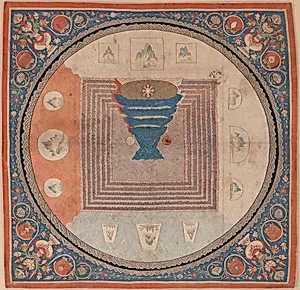
元 緙絲 須彌山曼陀羅|Cosmological Mandala with Mount Meru
Unknown Artist
14th century
Medium
Silk tapestry (kesi)
Dimensions
Overall: 33 x 33 in. (83.8 x 83.8cm) Mount: 37 1/4 x 38 x 2 3/8 in. (94.6 x 96.5 x 6 cm)
Classification
Textiles-Tapestries
Culture & Period
China · Yuan dynasty (1271–1368)
Department
Asian Art
Museum
Metropolitan Museum of Art, New York, NY
Credit
Purchase, Fletcher Fund and Joseph E. Hotung and Michael and Danielle Rosenberg Gifts, 1989
Accession Number
1989.140
Rights
Public Domain
Tags
Art Historical Context
This exquisite silk tapestry, known as *Cosmological Mandala with Mount Meru*, was created in 14th-century China during the Yuan dynasty. Woven in the intricate kesi technique, it depicts Mount Meru—the sacred axis mundi at the center of Buddhist and Hindu cosmology—surrounded by layered realms, deities, and symbolic motifs that map the universe. The square composition, measuring just over two feet, reflects the mandala’s role as a meditative diagram guiding viewers toward spiritual enlightenment. Kesi weaving, prized for its tapestry-like precision and ability to render fine details without embroidery, was a luxury art form favored by the imperial court and religious institutions. Under Mongol rule, such works often blended Chinese textile traditions with influences from Tibetan Buddhism and Central Asian cultures, highlighting the dynasty’s vast connections across Eurasia. Today housed in the Metropolitan Museum of Art, this rare surviving example offers a vivid window into Yuan-era religious thought and craftsmanship, where art served both as devotion and a visual cosmology for contemplation.