
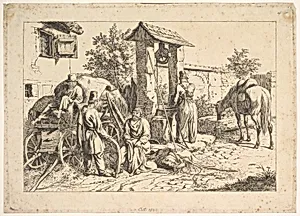
Cossack at the Well
Medium
Etching; before first state
Dimensions
plate: 7 x 9 3/4 in. sheet: 7 1/4 x 10 in.
Classification
Prints
Department
Drawings and Prints
Museum
Metropolitan Museum of Art, New York, NY
Credit
The Elisha Whittelsey Collection, The Elisha Whittelsey Fund, 1969
Accession Number
69.582.3
Rights
Public Domain
Tags
Art Historical Context
Created in 1815 by the German etcher Johann Christoph Erhard, *Cossack at the Well* captures a quiet moment of respite amid travel or military life. The scene depicts a lone Cossack—likely a Russian or Ukrainian horseman—pausing at a rustic well, accompanied by horses and carriages. Rendered in etching, the work showcases Erhard’s skill at suggesting texture and atmosphere through delicate, precise lines, even in this rare impression taken before the first formal state of the plate. Etchings like this one were prized in the early nineteenth century for their ability to circulate images widely while preserving an artist’s spontaneous touch. Produced in the wake of the Napoleonic Wars, when Cossack troops had become familiar figures across Europe, the print evokes both the romance of distant lands and the everyday realities of soldiers on the move. Its modest scale invites close looking, rewarding viewers with subtle details of harness, clothing, and the play of light on water. Today housed in the Metropolitan Museum’s Department of Drawings and Prints as part of the Elisha Whittelsey Collection, the etching offers a window onto Romantic-era interest in genre scenes drawn from real-world encounters. Its “before first state” status makes it especially valuable for understanding how printmakers refined their compositions.
About the Artist
Johann Christoph Erhard · 1795–1822
Johann Christoph Erhard (1795–1822) was a German painter and etcher of the Romantic era whose sensitive landscape studies and skillful prints earned him a growing reputation before his tragically early death at twenty-six. Born in Nuremberg, he studied at the Nuremberg Academy and later in Munich, where he was influenced by the Romantic landscape tradition and the revival of interest in the art of...