
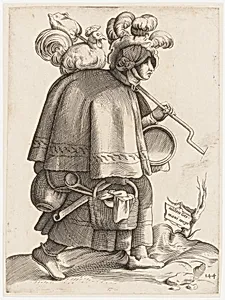
Costume Plate: Wife of a Warrior from Germany
ca. 1558–70
Medium
Engraving
Dimensions
sheet: 5 7/8 x 4 7/16 in. (15 x 11.2 cm)
Classification
Prints
Department
Drawings and Prints
Museum
Metropolitan Museum of Art, New York, NY
Credit
Harris Brisbane Dick Fund, 1953
Accession Number
53.600.830
Rights
Public Domain
Tags
Art Historical Context
In this engraving, a woman appears in profile, striding forward while heavily burdened with household objects. She wears a close-fitting cap topped with curling plumes and a live rooster perched on her shoulders. A wide cloak drapes over her torso, and additional pots, ladles, and a basket hang from her waist and back; one hand grasps a shallow pan and a long-handled tool. The fine parallel lines and cross-hatching typical of engraving create subtle shading and texture across the figure and the sparse ground beneath her feet. Enea Vico produced this print around 1558–70 as part of a series of costume plates. Working in Italy during the mid-sixteenth century, he specialized in reproductive engravings that recorded dress, customs, and armor from various regions. The sheet’s modest size allowed such images to circulate widely among collectors and artists interested in the variety of European fashions. Titled *Costume Plate: Wife of a Warrior from Germany*, the work offers a vivid record of how printmakers of the period documented social roles through detailed costume studies. Viewers today can appreciate both the technical precision of Vico’s line and the glimpse it provides into Renaissance curiosity about the wider world.
About the Artist
Enea Vico · 1523–1567
Enea Vico (1523–1567) was born in Parma and came of age during the final, energetic decades of Italian Renaissance printmaking. By 1541 he had made his way to Rome, where he entered the orbit of the engraver and publisher Tommaso Barlacchi and began his professional career. In Rome, Vico encountered the work of the most celebrated printmakers of the preceding generation—Marcantonio Raimondi, Agost...