
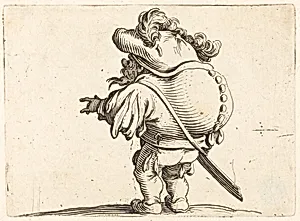
The Hunchback with the Feathered Cap
c. 1622
Medium
etching and engraving on laid paper
Dimensions
plate: 6.3 × 8.6 cm (2 1/2 × 3 3/8 in.) sheet: 9.2 × 10.4 cm (3 5/8 × 4 1/8 in.)
Classification
Department
CG-E
Museum
National Gallery of Art, Washington, D.C.
Credit
R.L. Baumfeld Collection
Accession Number
1969.15.436
Rights
Public Domain
Art Historical Context
In this compact etching, a single figure stands with his back to us, feet planted firmly on a thin ground line. His hunched shoulders and rounded form are accentuated by a large, plumed cap that flops to one side, while curly hair escapes beneath its brim. He wears a tightly buttoned doublet, loose breeches, and a sword slung at his hip; one gloved hand reaches forward in a lively gesture. Fine, precise lines describe the folds of fabric and the texture of feathers, all rendered in crisp black ink on a small sheet of laid paper. Jacques Callot made The Hunchback with the Feathered Cap around 1622 using etching and engraving. A master of small-scale printmaking, Callot specialized in capturing the energy and variety of human types with remarkable clarity and economy. His prints often reflect the lively street life and theatrical characters he observed during his travels across Europe in the early seventeenth century. This work rewards close looking, revealing how Callot could convey personality and movement within just a few inches. The result is both witty and humane, inviting viewers to appreciate the dignity he found even in exaggerated or marginal figures.
About the Artist
Jacques Callot · 1592–1635
Jacques Callot (1592–1635) was a French printmaker and draftsman from the Duchy of Lorraine, widely regarded as one of the first great artists to practice the graphic arts exclusively. His more than 1,400 etchings chronicled the breadth of 17th-century life, from Medici court festivities to the brutal realities of warfare. Callot revolutionized etching through technical innovations including the é...