
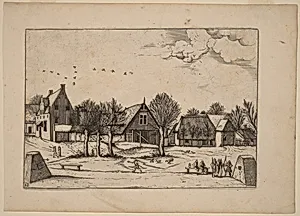
Country Village
published in or before 1676
Medium
etching retouched with engraving
Classification
Department
CG-E
Museum
National Gallery of Art, Washington, D.C.
Credit
Ailsa Mellon Bruce Fund
Accession Number
1972.28.71
Rights
Public Domain
Art Historical Context
**Country Village** is a captivating etching retouched with engraving by the skilled Dutch brothers Johannes van Doetech the Elder and Lucas van Doetechum, created after the anonymous Master of the Small Landscapes. Published or before 1676, this print belongs to a renowned 16th-century series that celebrated the humble charm of rural Flanders. Emerging during the Renaissance, when landscape art blossomed as an independent genre, these works drew inspiration from artists like Pieter Bruegel the Elder, capturing everyday village life with meticulous detail—from thatched cottages and winding paths to bustling peasants and livestock. The van Doetechums, pioneering reproductive printmakers associated with Antwerp's innovative publishing house of Hieronymus Cock, masterfully combined etching's fluid, spontaneous lines with engraving's crisp precision. This hybrid technique allowed for intricate textures, like the shimmering foliage and distant hills, making the small-scale print remarkably vivid and accessible. Such methods democratized fine art, spreading Northern Renaissance ideals of nature's beauty and human harmony far beyond elite circles. Housed in the National Gallery of Art's CG-E department through the Ailsa Mellon Bruce Fund, **Country Village** evokes a timeless nostalgia for pre-industrial serenity, reminding us how 16th-century innovators laid the groundwork for modern landscape traditions. A delightful window into Flemish countryside life! (198 words)
About the Artist
Johannes van Doetechum, the Elder and Lucas van Doetechum after Master of the Small Landscapes
**Johannes van Doetechum the Elder and Lucas van Doetechum: Masters of the Small Landscapes** Johannes van Doetechum the Elder, born around 1530 in Deventer in the northern Netherlands, and his brother Lucas, active from 1554, formed one of the most prolific engraving teams of the 16th-century Netherlandish Renaissance. Hailing from a family of printmakers—Johannes was the son of Jan ter Heghe an...