
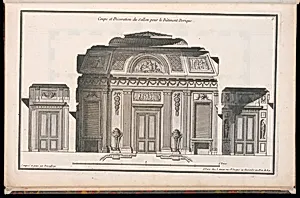
Coupe et Décoration du Sallon pour le Bâtiment Dorique
Medium
Classification
Department
Smithsonian Collection
Museum
Smithsonian American Art Museum
Credit
Purchased for the Museum by the Advisory Council
Accession Number
1921-6-451-15
Rights
Public Domain
About this artwork
Research in Progress
Art Historical Context
Jean-François de Neufforge a Flemish architect and engraver (1714–1791), created *Coupe et Décoration du Sallon pour le Bâtiment Dorique* in 1768. This intricate print, now in the Smithsonian American Art Museum's collection (purchased by the Advisory Council), captures the neoclassical fascination with ancient Greek architecture during the Enlightenment. Neufforge specialized in detailed architectural illustrations, blending Flemish precision with emerging neoclassical ideals that revived classical forms for modern design. The title translates to "Section and Decoration of the Salon for the Doric Building," depicting a cross-section and ornamental details of an elegant interior room inspired by the Doric order—the simplest and most robust of the three classical Greek columns, known for its sturdy fluted shafts and plain capitals. Produced as an affordable print medium, it served as inspiration for architects, designers, and patrons, disseminating sophisticated ideas across Europe amid a wave of antiquarian revival. Though research continues, this work exemplifies 18th-century efforts to harmonize antiquity with contemporary luxury, highlighting prints' role in democratizing high architecture. Visitors will appreciate its technical finesse and timeless appeal in evoking grand, orderly spaces.