
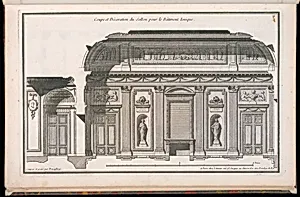
Coupe et Décoration du Sallon pour le Bâtiment Ionique
Medium
Classification
Department
Smithsonian Collection
Museum
Smithsonian American Art Museum
Credit
Purchased for the Museum by the Advisory Council
Accession Number
1921-6-451-18
Rights
Public Domain
About this artwork
Research in Progress
Art Historical Context
Jean-François de Neufforge, a architect and engraver (1714–1791), created *Coupe et Décoration Sallon pour le Biment Ionique* in 1768 as part of his influential *Recueil élémentaire d*, a multi-volume series of prints showcasing innovative designs. This work, a detailed print now in the Smithsonian American Art's collection (purchased by the Advisory Council), captures a cross-section (coupe) and decorative elements of a grand salon tailored to the Ionic order—a classical Greek architectural style revived during the 18th-century Neoclassical movement. The Ionic order, with its elegant volute capitals, symbolized refined harmony and was popular among Enlightenment-era architects seeking to blend antiquity with modern luxury. Neufforge's precise engraving technique allowed for intricate renderings of moldings, columns, and ornamental details, making complex designs accessible to builders, decorators, and patrons across Europe. As a print medium, this piece exemplifies how 18th-century graphic arts democratized architecture, influencing interiors from Parisian salons to American colonial homes. Its presence in the Smithsonian highlights the transatlantic exchange of stylistic ideas during a time of cultural revival. (198 words)