
Couple Embracing
1911
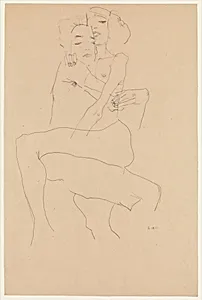
Medium
Graphite on paper
Dimensions
22 5/8 × 15 in. (57.5 × 38.1 cm)
Classification
Drawings
Department
Modern and Contemporary Art
Museum
Metropolitan Museum of Art, New York, NY
Credit
Bequest of Scofield Thayer, 1982
Accession Number
1984.433.312
Rights
Public Domain
Tags
Art Historical Context
In 1911, Austrian Expressionist Egon Schiele captured raw human intimacy in *Couple Embracing*, graphite drawing on paper measuring 22 5/8 × 15 inches. At just 21 years old, Schiele at the forefront of Vienna's avant-garde scene, influenced by his mentor Gustav Klimt and Secession movement. This work exemplifies his early style: stark, angular lines and distorted figures that convey psychological tension and erotic energy, hallmarks of Expressionism's rejection of classical beauty for emotional truth. Rendered in graphite, the medium allowed Schiele's masterful economy of line—sharp contours and subtle shading—to evoke the couple's passionate embrace, with the female nude's form highlighting themes of desire and vulnerability. Such intimate subjects often scandalized contemporaries, reflecting the era's shifting views on sexuality amid pre-World War I cultural upheaval. Now in the Metropolitan Museum of Art's Modern and Contemporary Art Department, thanks to the 1982 bequest of Scofield Thayer, this drawing remains a poignant testament to Schiele's brief but brilliant career, cut short by his death in 1918 at age 28. Visitors are drawn to its unflinching honesty, a window into the human condition.
About the Artist
Egon Schiele · 1890–1918
Egon Schiele (1890-1918) stands as one of the most provocative and psychologically penetrating artists of early twentieth-century European modernism. Born in Tulln an der Donau, Austria-Hungary, Schiele's brief but intensely productive life ended tragically at age twenty-eight when he and his pregnant wife Edith succumbed to the Spanish flu pandemic, mere days apart. Despite his truncated career, ...