
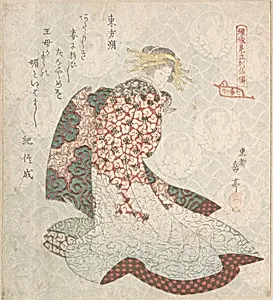
Courtesan
19th century
Medium
Woodblock print (surimono); ink and color on paper
Dimensions
8 1/16 x 7 5/16 in. (20.5 x 18.6 cm)
Classification
Prints
Culture & Period
Japan · Edo period (1615–1868)
Department
Asian Art
Museum
Metropolitan Museum of Art, New York, NY
Credit
H. O. Havemeyer Collection, Bequest of Mrs. H. O. Havemeyer, 1929
Accession Number
JP2127
Rights
Public Domain
Tags
Art Historical Context
Step into the enchanting world of Edo-period Japan with *Courtesan*, a delicate surimono woodblock print by Yashima Gakutei (active 1810s–1840s). Created in the 19th century, this 8 x 7-inch artwork captures the poised elegance of a courtesan, a celebrated figure in ukiyo-e—the "pictures of the floating world" that romanticized urban pleasures like the Yoshiwara pleasure district. Gakutei, a master of this genre, specialized in bijin-ga (images of beautiful women), blending poetic refinement with visual allure. Surimono, meaning "printed things," were luxurious, privately commissioned prints often produced for New Year's greetings or poetry gatherings. Unlike mass-produced ukiyo-e, they showcase superior craftsmanship: intricate carving for fine lines, vibrant mineral colors, and subtle textures like mica dusting or embossing on the paper. This medium allowed Gakutei to evoke the courtesan's graceful kimono folds and serene expression with mesmerizing detail, reflecting the era's obsession with transient beauty. From the Metropolitan Museum of Art's H. O. Havemeyer Collection, *Courtesan* offers a window into Japan's vibrant Edo culture (1615–1868), where art democratized high-society glamour. Pause to admire her subtle gaze— a testament to Gakutei's skill in conveying quiet allure amid fleeting pleasures.
About the Artist
Yashima Gakutei · 1786–1868
Yashima Gakutei (c. 1786–1868), born in Osaka as the illegitimate son of a Tokugawa shogunate samurai named Hirata, adopted the name from his mother's subsequent marriage into the Yashima clan. Little is documented about his early years beyond these familial ties, but he pursued artistic training under the esteemed ukiyo-e masters Totoya Hokkei and Katsushika Hokusai, absorbing their precision in ...