
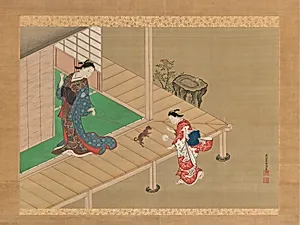
Courtesan and Attendant Playing with a Dog
ca. 1716–1736
Medium
Hanging scroll; ink and color on silk
Dimensions
Image: 23 × 32 3/4 in. (58.4 × 83.2 cm) Overall with mounting: 60 1/2 × 38 1/2 in. (153.7 × 97.8 cm) Overall with knobs: 60 1/2 × 41 5/8 in. (153.7 × 105.7 cm)
Classification
Paintings
Culture & Period
Japan · Edo period (1615–1868)
Department
Asian Art
Museum
Metropolitan Museum of Art, New York, NY
Credit
Gift of Florence and Herbert Irving, 2015
Accession Number
2015.500.9.49
Rights
Public Domain
Tags
Art Historical Context
Created during Japan’s Edo period (1615–1868), *Courtesan and Attendant Playing with a Dog* captures the refined elegance of urban life in Kyoto. Nishikawa Sukenobu, a leading artist of the time, specialized in graceful depictions of women that would later influence the popular ukiyo-e print tradition. The hanging scroll format, painted in ink and color on silk, was prized for its luminous surface and portability, allowing such works to be displayed seasonally in private homes or teahouses. The scene itself reflects the cultural fascination with courtesans as symbols of beauty, wit, and fleeting pleasure. By showing the central figure and her attendant engaged in the simple delight of playing with a small dog, Sukenobu humanizes these celebrated women and invites viewers to appreciate a moment of everyday warmth rather than formal portraiture. The careful rendering of flowing robes and expressive gestures highlights the artist’s skill in conveying both status and personality through delicate brushwork. Today in the Metropolitan Museum’s Asian Art collection, the painting offers a window into the refined tastes of eighteenth-century Japan, where art celebrated the transient joys of the “floating world.”
About the Artist
Nishikawa Sukenobu · 1671–1751
Japanese, 1671–1750