
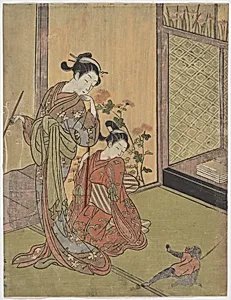
Two Girls Looking at a Monkey on a Leash
Medium
Woodblock print; ink and color on paper
Dimensions
H. 10 1/4 in. (26 cm); W. 7 13/16 in. (19.8 cm)
Classification
Prints
Culture & Period
Japan · Edo period (1615–1868)
Department
Asian Art
Museum
Metropolitan Museum of Art, New York, NY
Credit
H. O. Havemeyer Collection, Bequest of Mrs. H. O. Havemeyer, 1929
Accession Number
JP1630
Rights
Public Domain
Tags
Art Historical Context
Suzuki Harunobu's *Two Girls Looking at a Monkey on Leash* captures a charming moment of everyday curiosity in Edo-period Japan (1615–1868). Created as a woodblock print with ink and color on paper this intimate scene measures just 10¼ × 7⅞ inches, perfect for the popular ukiyo-e ("pictures of the floating world") tradition that celebrated fleeting pleasures like urban life and entertainment. Harunobu, a master of the genre, pioneered full-color nishiki-e prints around 1765, using multiple woodblocks to layer vibrant hues with remarkable precision. The artwork's delicate lines and soft palette highlight the girls' wide-eyed wonder as they gaze at the leashed monkey—a nod to street performers common in bustling Edo (modern Tokyo). Monkeys symbolized playfulness and transience in Japanese culture, adding whimsy to this slice of daily life. Harunobu's style, blending realism with poetic grace, influenced generations of printmakers and brought affordable beauty to commoners. Housed in the Metropolitan Museum of Art's Asian Art Department from the H.O. Havemeyer Collection, this print invites us to pause and appreciate the simple joys that defined Edo society.
About the Artist
Suzuki Harunobu · 1725–1770
Suzuki Harunobu (c. 1725-1770) was a Japanese ukiyo-e artist who revolutionized woodblock printing by developing nishiki-e—full-color prints using multiple woodblocks—in 1765. Before Harunobu, Japanese prints were limited to two or three colors; his innovation unleashed the entire artist's palette, transforming ukiyo-e into the vibrant art form that would later captivate Western artists from Manet...