
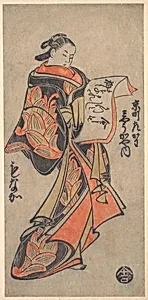
Courtesan from the Myōgaya House
ca. 1712
Medium
Woodblock print (tan-e); ink and color on paper
Dimensions
12 1/4 x 6 in. (31.1 x 15.2 cm)
Classification
Prints
Culture & Period
Japan · Edo period (1615–1868)
Department
Asian Art
Museum
Metropolitan Museum of Art, New York, NY
Credit
Harris Brisbane Dick Fund and Rogers Fund, 1949
Accession Number
JP3073
Rights
Public Domain
Tags
Art Historical Context
Step into the alluring "floating world" of Edo-period Japan (1615–1868) with *Courtesan from the Myōgaya House*, ablock print by Torii Kiyomasu, created around 1712. This intimate tan-e—or "red picture"—employs ink and subtle color on paper, measuring just 12¼ × 6 inches, capturing a poised courtesan from the famed Myōgaya House Yoshiwara, Tokyo's licensed pleasure quarter. These women were cultural icons, blending elegance, artistry, and sensuality in a society where such pursuits offered escape from rigid samurai hierarchies. Torii Kiyomasu I, a master of the Torii school, helped pioneer ukiyo-e, the popular print genre celebrating everyday beauties and entertainers. His bold lines and vibrant reds in tan-e technique—using vermilion pigments layered via woodblocks—brought dynamic life to bijin-ga (pictures of beautiful women), making art accessible beyond elites through affordable multiples. This Metropolitan Museum of Art gem highlights woodblock printing's revolutionary role in democratizing visual culture, preserving the glamour of courtesan life while showcasing early color innovation that paved the way for masters like Utamaro and Hokusai. A window into Japan's playful, prosperous urban scene!
About the Artist
Torii Kiyomasu I · 1696–1716
Torii Kiyomasu I was a Japanese ukiyo-e artist working in the early eighteenth century, closely associated with the Torii school, one of the most important lineages in the history of Japanese woodblock printmaking. The Torii school was founded by Torii Kiyonobu, and Kiyomasu I is believed to have been either his son or a close pupil — the precise family relationship remains a matter of scholarly d...