
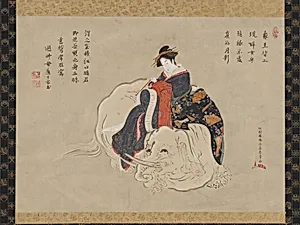
勝川春章筆 佛母恵選賛 江口の君図|Courtesan of Eguchi
painting:1770−80; inscription: 1820s–30s
Medium
Hanging scroll; ink and color on paper
Dimensions
Image: 14 7/8 × 20 7/16 in. (37.8 × 51.9 cm) Overall with mounting: 48 1/16 × 25 1/4 in. (122 × 64.1 cm) Overall with knobs: 48 1/16 × 27 3/8 in. (122.1 × 69.5 cm)
Classification
Paintings
Culture & Period
Japan · Edo period (1615–1868)
Department
Asian Art
Museum
Metropolitan Museum of Art, New York, NY
Credit
Mary and Cheney Cowles Collection, Gift of Mary and Cheney Cowles, 2018
Accession Number
2018.853.26
Rights
Public Domain
Tags
Art Historical Context
This exquisite hanging scroll, *Courtesan of Eguchi*, painted by the renowned ukiyo-e masterukawa Shunshō around 1770–80 Japan's Edo period (1615–1868). Shunshō, celebrated for his vibrant depictions of beautiful women (*bijin-ga*) and actors, captures the legendary figure of Eguchi no Kimi courtesan from a famous Noh play and Buddhist folktale. Rendered in ink and delicate colors on paper, the work measures about 15 × 20 inches, designed for intimate display in a tokonoma alcove, blending everyday elegance with spiritual depth. The subject draws from the tale of Eguchi, where a courtesan entertains a monk pilgrim, only to reveal her true form as Fugen Bosatsu, the bodhisattva of wisdom who rides a white elephant. Here, Shunshō artfully merges the worlds of the pleasure quarters and enlightenment: the graceful woman amid elephants symbolizes divine compassion disguised in mortal beauty, a motif rich in Japanese cultural syncretism. A later inscription by monk-artist Butsumo Keisen in the 1820s–30s praises it as "Butsumo" (Buddhist Mother), adding a poetic layer centuries after creation. Shunshō's technique shines in his fluid lines, subtle gradations of color, and evocative details—like the elephants' majestic forms—that evoke both sensuality and serenity. Part of the Metropolitan Museum of Art's Asian Art collection, this scroll highlights Edo Japan's fascination with *yūgen* (profound grace), inviting viewers to ponder the sacred hidden in the profane.
About the Artist
Katsukawa Shunshō 勝川春章|Butsumo Keisen (Japanese) · 1726 –1792
Japanese, 1726–1792