
Courtesan
ca. 1796-1798
Classification
Painting
Department
Smithsonian Collection
Museum
Smithsonian American Art Museum
Credit
Gift of Charles Lang Freer
Accession Number
F1903.129
Rights
Public Domain
Tags
About this artwork
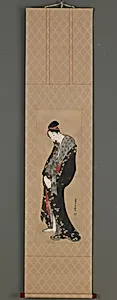
The woman portrayed in this early painting by Hokusai holds the edge of her garment in her mouth, a gesture that signifies passion, perhaps inspired by the love letter she clutches in her right hand. Her sinuous pose, curved like a reversed "S", is highly stylized and closely resembles the pose portrayed in The Princess from the Land of Porcelain, painted by James McNeill Whistler (1834-1903) and exhibited in the Freer gallery's Peacock Room. Whistler's work reflects many ideas from his observat...
Art Historical Context
Step into the vibrant world of Edo-period Japan (1615-1868) with *Courtesan*, an early painting by the legendary Katsushika Hokusai (1760-1849), created around 1796-1798. Hokusai, a master of ukiyo-e—the "pictures of the floating world" that captured fleeting pleasures like theater, beauty, and urban life—crafted this kakemono, a traditional hanging scroll painting. Depicting a poised courtesan, it reflects the era's fascination with elegant entertainers from the pleasure districts, blending sensuality with stylized grace. The woman's sinuous, reversed "S" pose is strikingly dynamic, her fingers clutching a love letter while she holds the edge of her garment in her mouth—a gesture symbolizing passion and desire. This highly stylized form showcases Hokusai's innovative line work and composition, hallmarks of his evolving style before his iconic print series like *The Great Wave*. Acquired in 1903 by collector Charles Lang Freer, who gifted it to the Smithsonian American Art Museum, the painting echoes in James McNeill Whistler's *The Princess from the Land of Porcelain* (also in Freer's Peacock Room). This cross-cultural link highlights Japonisme's influence on Western art, bridging Japanese tradition with global admiration.