
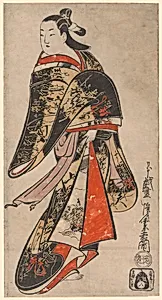
Courtesan Walking
c. 1714
Medium
Hand-colored woodblock print; tan-e, vertical o-oban
Dimensions
55.2 × 28.8 cm (21 3/4 × 11 3/8 in.)
Classification
woodblock print
Department
Arts of Asia
Museum
Art Institute of Chicago
Accession Number
127635
Rights
Public Domain
About this artwork
Woodblock prints are regarded as the most characteristic expression of the Japanese artistic genius. Great quantities of this popular art form, called ukiyo-e ("pictures of the floating world"), were made during the Edo period (1603-1868) and sold inexpensively to a pleasure-seeking public captivated by Kabuki theater, sumo wrestling, and the brothel districts. Prints such as Kaigetsudo's hand-painted Courtesan display a freedom and originality that were not possible in the rendering of traditio...
Art Historical Context
Step into the alluring world of early 18th-century Japan with *Courtesan Walking*, a captivating hand-colored woodblock print Kaigetsudo Anchi, created around 1714. This vertical ōban, measuring 55.2 × 28.8 cm, depicts a poised courtesan gliding through the Yoshiwara pleasure district of Edo (modern Tokyo). Anchi, a master of the Kaigetsō school, specialized in *bijin-ga*—images of beautiful women—rendering his subjects with voluptuous forms, flowing robes, and an air of elegant sensuality that captivated collectors. As a *tan-e* print, it showcases early ukiyo-e techniques using tan (ochre) pigments for lifelike flesh tones, hand-applied for vivid warmth before full-color *benizuri-e* and *nishiki-e* eras. Produced during the Edo period's cultural boom, these affordable woodblocks democratized art, celebrating the "floating world" of transient pleasures, fashion, and urban nightlife amid Japan's rigid social order. Housed in the Art Institute of Chicago's Arts of Asia department, this work highlights the Kaigetsudō school's influence on later giants like Utamaro. Its bold composition and intricate *yorozu no fushigi* patterns on the kimono evoke the courtesan's grace and the era's obsession with feminine allure, offering a window into a vibrant, hedonistic past.