
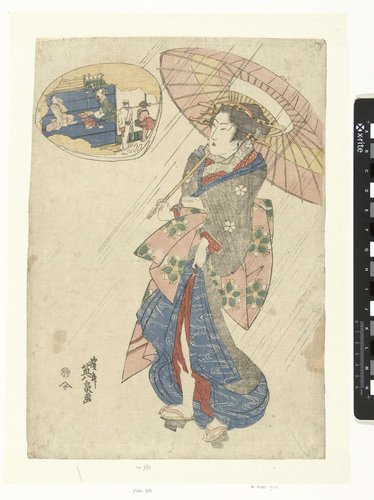
Courtisane in de regen
1820 - 1830
Medium
nishiki-e
Dimensions
380; 270
Rights
Public Domain
About this artwork
blad: hoogte 380 mm x breedte 270 mm
Art Historical Context
**Courtisane in de** by Keisai Eisen, created between 1820 and 1830, captures the fleeting beauty of a courtesan braving the rain in this exquisite *nishiki-e* wood print. Measuring 380 mm high by 270 mm wide—a standard *ōban* size—Eisen's work exemplifies the ukiyo-e tradition of depicting the "floating world" of Edo-period Japan, where pleasure quarters, geisha, and transient moments were celebrated. Keisai Eisen (1790–1848), a master of *bijin-ga* (pictures of beautiful women), blended delicate linework with vibrant colors to evoke elegance and melancholy. This print likely portrays a high-ranking courtesan, her kimono clinging poetically to her form amid the downpour, highlighting the era's fascination with feminine grace under everyday trials. As a *nishiki-e*—or "brocade picture"—it showcases the revolutionary multi-block printing technique, layering up to 20 colors for luminous depth unattainable in earlier monochrome works. Culturally, such prints democratized art, adorning homes and influencing global aesthetics, from Japonisme in Europe to modern design. A poignant glimpse into 19th-century Japan's urban sophistication.
About the Artist
Keisai Eisen · 1790–1848
Keisai Eisen (1790–1848), born Ikeda Yoshinobu in Edo (modern Tokyo), emerged as one of the late Edo period's most prolific ukiyo-e masters. The son of the renowned calligrapher and Kanō-school painter Ikeda Shigeharu, Eisen was immersed in the arts from childhood. He apprenticed under Kanō Hakkeisai, adopting the art name "Keisai" in homage to his teacher, and later studied bijin-ga (images of be...