
Courtyard of a Farm
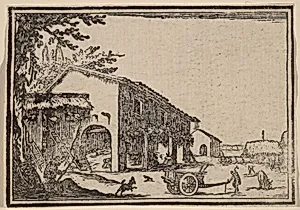
Medium
woodcut on laid paper
Dimensions
sheet (trimmed to block): 5.4 × 7.2 cm (2 1/8 × 2 13/16 in.)
Classification
Department
CG-E
Museum
National Gallery of Art, Washington, D.C.
Credit
R.L. Baumfeld Collection
Accession Number
1969.15.200
Rights
Public Domain
Art Historical Context
This small woodcut, titled *Courtyard of a Farm*, captures a quiet moment of rural life in early 17th-century Europe. Created in 1621 by Edouard Eckman after an original design by Jacques Callot, the print reflects the growing interest in everyday scenes during the Baroque period. Callot, a pioneering French printmaker, was celebrated for his lively depictions of peasants, soldiers, and courtly figures, often infusing ordinary subjects with narrative detail and vitality. Eckman’s adaptation brings this vision to a new audience through the woodcut medium. Measuring just over two by three inches, the intimate scale invites close viewing and highlights the precision required in carving the block. Woodcuts, among the oldest printmaking techniques, allowed images to be reproduced affordably on paper, spreading artistic ideas across regions at a time when travel and literacy were limited. Printed on laid paper, this work exemplifies how prints democratized art, moving it beyond palace walls into homes and collections. Today, *Courtyard of a Farm* resides in the National Gallery of Art’s R.L. Baumfeld Collection, offering modern viewers a window into both the rustic charm of its subject and the innovative spirit of early print culture.
About the Artist
Edouard Eckman after Jacques Callot
Edouard Eckman, a Flemish printmaker born around 1600, remains a somewhat enigmatic figure in art history, with his early life not well documented. Little is known about his training or formal education, though his oeuvre suggests familiarity with the vibrant printmaking traditions of the early Baroque period in Northern Europe. Active primarily in the second decade of the seventeenth century, Eck...