
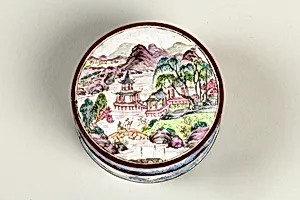
清乾隆 銅胎畫琺瑯山水圖蓋盒|Covered box
Unknown Artist
Medium
Painted enamel
Dimensions
H. 1 1/8 in. (2.9 cm); Diam. 2 5/8 in. (6.7 cm)
Classification
Enamels
Culture & Period
China · Qing dynasty (1644–1911), Qianlong period (1736–95)
Department
Asian Art
Museum
Metropolitan Museum of Art, New York, NY
Credit
Bequest of Mary Clark Thompson, 1923
Accession Number
24.80.464a, b
Rights
Public Domain
Tags
Art Historical Context
This exquisite covered box, crafted during the Qianlong period (1736–95) of China's Qing dynasty, exemplifies the imperial court's mastery of painted enamel on a copper base—a technique known as *tongti hualuo* in Chinese. Measuring just 1 1/8 inches high 2 5/8 inches in diameter its diminutive size suggests it was for personal use, perhaps to hold cosmetics, seals, or precious items. The lid features a vibrant painted enamel landscape, alive with rolling hills, graceful trees, sturdy buildings, arched bridges, and tiny human figures, evoking the harmonious ideals of traditional Chinese nature painting. Painted enamels flourished under the Qianlong emperor, a passionate collector and patron who oversaw workshops producing luxury goods blending European enamel techniques with Chinese motifs. Here, vivid colors—likely including blues, greens, and golds—are fused directly onto the copper body through multiple firings, creating a durable, jewel-like surface that rivals porcelain or jade in refinement. This fusion of materials and styles highlights the Qing era's cosmopolitan sophistication, influenced by Jesuit missionaries introducing Western enameling methods to the imperial kilns. Now housed in the Metropolitan Museum of Art thanks to the 1923 bequest of Mary Clark Thompson, this box offers a window into 18th-century elite life, where everyday objects became canvases for poetic scenes celebrating balance between humanity and nature. A true treasure for any visitor!