
Covered Jar
Unknown Artist
1840–60
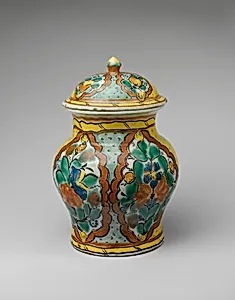
Medium
Tin-glazed earthenware
Dimensions
H. 11 1/4 in. (28.6 cm)
Classification
Jar
Culture
Mexican
Department
The American Wing
Museum
Metropolitan Museum of Art, New York, NY
Credit
Gift of Mrs. Robert W. de Forest, 1911
Accession Number
17.108.24a, b
Rights
Public Domain
Tags
Art Historical Context
This elegant Covered Jar, crafted by an unknown Mexican artist between 1840 and 1860, exemplifies the vibrant tradition of tin-glazed earthenware, a technique with roots in Spanish colonial influences. The tin glaze creates a smooth, opaque white surface ideal for bold painted designs, often featuring floral motifs like those hinted at here. Standing at 11¼ inches tall, this lidded vessel would have served both practical purposes—storing spices, grains, or confections—and decorative ones in a Mexican household, blending everyday utility with artistic flair. Produced during Mexico's post-independence era, when local pottery workshops thrived amid growing national identity, the jar reflects the enduring popularity of maiolica-style ceramics. These pieces were fired at low temperatures, allowing artisans to apply vivid, glossy colors that captured the beauty of native flowers, symbolizing abundance and nature's bounty in Mexican culture. Its presence in The American Wing of The Metropolitan Museum of Art, gifted by Mrs. Robert W. de Forest in 1911, highlights early 20th-century interest in cross-cultural exchanges between Mexico and the United States. Today, this jar invites us to appreciate the anonymous skill of Mexican potters, whose work bridged art and life in the 19th century, offering a tangible link to everyday artistry from a bygone era.