
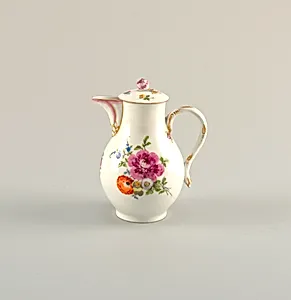
Covered Milk Jug
Classification
ceramics
Department
Smithsonian Collection
Museum
Smithsonian American Art Museum
Credit
Bequest of Erskine Hewitt
Accession Number
1938-57-521-a,b
Rights
Public Domain
About this artwork
Research in Progress
Art Historical Context
This elegant Covered Milk Jug, crafted by the renowned Meissen Porcelain Manuf in Germany during the mid-19 century, exemplifies the pinnacle of European ceramic artistry. Founded in 1710 the patronage of Augustus the Strong,or of Saxony, Meissen achieved a groundbreaking feat by developing the first true hard-paste porcelain in—a secret long held by Chinese artisans. This innovation produced a durable, translucent "white gold" that revolutionized luxury goods, blending functionality with exquisite decoration. As a piece of tableware, the jug highlights Meissen's mastery of techniques like wheel-throwing, intricate modeling, and overglaze enameling or gilding, often seen in their Rococo and later neoclassical styles. In the 19th century, amid industrial advances, Meissen maintained its artisanal prestige, supplying royalty and elites with finely painted services that elevated everyday rituals to art. Though specific decorative details await further research, such vessels symbolized refined taste and technical virtuosity. Now part of the Smithsonian American Art Museum's collection through the bequest of collector Erskine Hewitt, this jug invites us to appreciate Meissen's enduring legacy—from its 18th-century origins to its present-day vitality—bridging historical innovation with timeless beauty.