
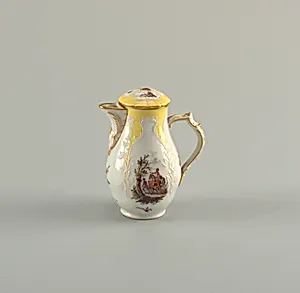
Covered Creamer with Battle Scenes (Bataillen-Malerei)
Classification
ceramics
Department
Smithsonian Collection
Museum
Smithsonian American Art Museum
Credit
Bequest of Georgiana L. McClellan
Accession Number
1953-17-47-a,b
Rights
Public Domain
About this artwork
Research in Progress
Art Historical Context
This elegant covered creamer, titled *Covered Creamer with Battle ScenesBataillen-Malerei, hails from the Royal Porcelain Manufactory Berlin, Germany—established in 1763 as a pinnacle of European porcelain production under royal patronage. Crafted between 1870 and 1900, it exemplifies theactory's mastery of fine ceramics, blending utilitarian tableware with intricate decorative artistry. The "battle scenes" motif, a popular theme in 19th-century German porcelain, likely draws from historical military triumphs, evoking the era's nationalistic fervor following Germany's unification in 1871. As a piece of KPM porcelain, it would have been produced using sophisticated techniques like underglaze painting or enamel decoration, fired to achieve the translucent glow and durability synonymous with Berlin's royal wares. These creamers were prized in affluent households for tea services, transforming everyday rituals into displays of sophistication and patriotism. The vivid battle imagery reflects Prussian cultural pride, immortalizing conflicts like the Franco-Prussian War on delicate forms. Now part of the Smithsonian American Art Museum through the bequest of Georgiana L. McClellan, this creamer invites us to ponder how porcelain captured the spirit of imperial Germany. Though research continues, it stands as a tangible link to a golden age of ceramic innovation.