
Covered Sugar Bowl
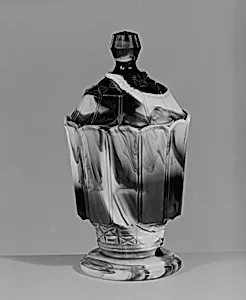
Medium
Pressed purple marble glass
Dimensions
H. 8 1/2 in. (21.6 cm); Diam. 4 1/2 in. (11.4 cm)
Classification
Sugar bowl
Culture
American
Department
The American Wing
Museum
Metropolitan Museum of Art, New York, NY
Credit
Gift of Mrs. Emily Winthrop Miles, 1946
Accession Number
46.140.642a, b
Rights
Public Domain
Art Historical Context
Step into the refined world of late 19th-century American life with this elegant *Covered Sugar Bowl* crafted by Challinor, Taylor and Company 1870 and 1890. Standing at 8½ inches tall with a 4½-inch diameter, this piece from pressed purple marble glass exemplifies era's love for ornate yet accessible tableware. The deep purple hue, achieved through swirling opaque glass that mimics luxurious marble, adds a touch of opulence to everyday tea services. Challinor, Taylor and, based in Pennsylvania, were pioneers in the American pressed glass industry—a revolutionary technique where molten glass was forced into intricate molds under pressure. This method democratized beauty, allowing middle-class households to enjoy elaborate designs once reserved for the elite. The purple marble effect, a specialty of the period, created a stone-like translucency that captured light beautifully, highlighting the bowl's geometric patterns and domed lid. Housed in The Metropolitan Museum of Art's American Wing, this sugar bowl—generously gifted by Mrs. Emily Winthrop Miles in 1946—reflects the Gilded Age's blend of industrial innovation and Victorian aesthetics. It invites us to imagine family gatherings sweetened by its presence, a testament to America's burgeoning glassmaking prowess.
About the Artist
Challinor, Taylor and Company · 1866–1891
Challinor, Taylor and Company was an American pressed glass manufacturer founded in 1866 and based in Tarentum, Pennsylvania, a community along the Allegheny River that was home to several of the nineteenth century's most innovative glassmakers. The firm operated until 1891, when it was absorbed into the United States Glass Company as Factory C — part of the great industrial consolidation that res...