
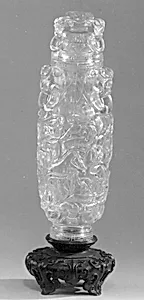
Covered vase with stand
Unknown Artist
19th century
Medium
Crystal
Dimensions
H. (with stand) 6 5/8 in. (16.8 cm); Diam. 2 1/8 in. (5.4 cm)
Classification
Hardstone
Culture
China
Department
Asian Art
Museum
Metropolitan Museum of Art, New York, NY
Credit
Alfred W. Hoyt Collection, Bequest of Rosina H. Hoppin, 1965
Accession Number
65.86.67a–c
Rights
Public Domain
Art Historical Context
This delicate covered vase with stand, crafted in crystal during China's 19th century, exemplifies the refined artistry of the Qing dynasty era. Standing just 6 5/8 inches tall with its base and measuring 2 1/8 inches in diameter, its petite scale suggests it was designed for intimate display—perhaps on a scholar's desk or as part of a decorative ensemble in a refined household. Classified as a hardstone carving, the translucent crystal medium highlights the lapidary's mastery, where quartz was meticulously shaped and polished to achieve a luminous, jewel-like quality. In Chinese culture, such vases held both practical and symbolic value, often used to store precious oils, incense, or spices, while their covered form evoked harmony and containment—core tenets of Confucian aesthetics. The 19th century saw continued imperial patronage of these luxury objects, blending functionality with opulent display amid a flourishing export trade. Though the artist remains unknown, the precision of the carving speaks to specialized workshops in regions like Liangshan, known for hardstone work. Now housed in the Metropolitan Museum of Art's Asian Art Department, this piece from the Alfred W. Hoyt Collection (bequest of Rosina H. Hoppin, 1965) invites visitors to appreciate the subtle elegance of everyday imperial luxury, where clarity of material mirrored the pursuit of perfection.