
Coverlet
1841
Medium
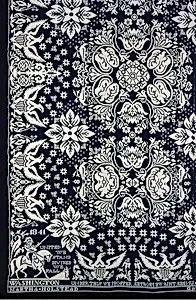
Cotton and wool, plain weave double cloth; woven on loom with Jacquard attachment; two loom widths joined
Dimensions
223.7 × 179 cm (88 × 70 1/2 in.)
Classification
weaving - coverlet
Department
Textiles
Museum
Art Institute of Chicago
Accession Number
64670
Rights
Public Domain
Art Historical Context
This striking coverlet, woven in 1841 by James Cunningham, exemplifies the innovative spirit of mid-nineteenth-century American textile. Measuring over seven feet in length, the double-cloth weaving combines cotton and wool in a durable yet visually rich. Created on a loom fitted with a Jacquard attachment, the piece reflects the early adoption of this revolutionary technology, which used punched cards to control intricate patterns—foreshadowing modern computing while enabling weavers to produce complex designs with greater efficiency than traditional methods. The coverlet’s construction, formed from two loom widths joined together, highlights the practical craftsmanship of the era. Professional weavers like Cunningham supplied households with these warm, decorative bed coverings that blended utility with artistic expression. The plain-weave double-cloth technique creates a reversible fabric where patterns appear in contrasting colors on each side, demonstrating both technical skill and an eye for balanced design. As a product of its time, this textile captures the transition from handcraft to mechanized industry during the Industrial Revolution. Today it offers visitors a tangible connection to the daily lives and creative ingenuity of nineteenth-century Americans who valued both beauty and function in their homes.