
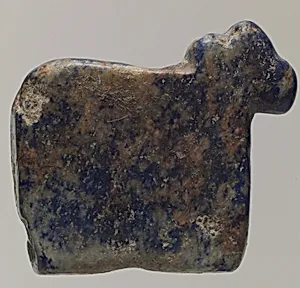
Cow amulet
Unknown Artist
ca. 2900–2350 BCE
Medium
Lapis lazuli
Dimensions
0.18 x 0.89 x 0.79 in. (0.46 x 2.26 x 2.01 cm)
Classification
Stone-Ornaments
Culture & Period
Sumerian · Early Dynastic
Department
Ancient Near Eastern Art
Museum
Metropolitan Museum of Art, New York, NY
Credit
Rogers Fund, 1959
Accession Number
59.41.45
Rights
Public Domain
Tags
About this artwork
This stone-ornaments from Sumerian, Early Dynastic, Mesopotamia, dating to ca. 2900–2350 BCE, provides valuable insight into the artistic practices and material culture of its era. Created in lapis lazuli, this work embodies the material practices and technical knowledge of its era. Artists' choices of materials reflected both practical availability and symbolic associations, with different media carrying distinct cultural meanings and artistic possibilities. Understanding historical techniques ...
Art Historical Context
This delicate cow amulet, crafted from vibrant lapis lazuli around 2900–2350 BCE, hails from Sumerian Early Dynastic Mesopotamia—one of the world's earliest urban civilizations. Measuring just 0.18 x 0.89 x 0.79 inches, tiny stone ornament exemplifies the exquisite miniaturization of ancient art, likely worn as jewelry or a protective talisman. Produced by an unknown artist, it reflects the anonymous workshop traditions typical of the era, where collective skills produced objects blending utility and symbolism. Lapis lazuli, a deep-blue stone imported from distant Afghanistan, was reserved for elite goods, underscoring the amulet's status and the Sumerians' advanced trade networks. Carving such hard material into a lifelike cow form demanded remarkable technical precision, highlighting sophisticated lapidary techniques that linked earthly life to divine realms in Mesopotamian culture. Cows held profound significance in Sumerian society, symbolizing fertility, abundance, and prosperity amid the fertile Tigris-Euphrates river valleys. As part of the Metropolitan Museum of Art's Ancient Near Eastern collection (Rogers Fund, 1959), this amulet offers a tangible glimpse into early human ingenuity, inviting us to marvel at how a small blue bovine bridged the ancient world and our own.