
Craibe Angus
1877/1880
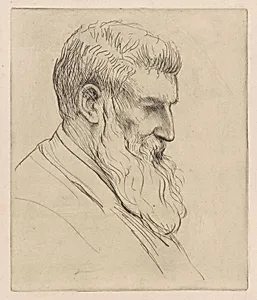
Medium
drypoint
Classification
Department
CG-E
Museum
National Gallery of Art, Washington, D.C.
Credit
Corcoran Collection (Gift of E. Gerald Lamboley)
Accession Number
2015.143.1366
Rights
Public Domain
Art Historical Context
**Craibe Angus** is a striking drypoint etching by Alphonse Legros created between 1877 and 1880. Legros, a French-born artist who spent much of his career in, was a master printmaker renowned for his realistic portrayals infused with a subtle psychological depth. This work, housed in the National Gallery of's Corcoran CollectionGift of E. Gerald Lamboley), exemplifies his skill during a period when he was professor at the Slade School of Fine Art in London, influencing a generation of British artists. Drypoint, the medium here, involves scratching directly into a metal plate with a sharp tool, raising a soft burr that captures ink for richly textured, velvety lines. Unlike etching, which uses acid for precise grooves, drypoint's intimate, hand-drawn quality lends an immediacy and warmth, often limited to small editions due to the plate's quick wear. Legros drew inspiration from Rembrandt's techniques, elevating printmaking to fine art in the 19th century. As part of the Prints department (CG-E classification), **Craibe Angus** highlights the Corcoran Gallery's legacy of collecting exceptional 19th-century works. Visitors will appreciate its technical finesse and Legros's ability to convey character through minimal means, bridging French Realism and British academic traditions.
About the Artist
Alphonse Legros · 1837–1911
Alphonse Legros (1837–1911) was born in Dijon, France, and trained in Paris at the drawing school of Horace Lecoq de Boisbaudran, whose unconventional teaching method — which emphasised memory drawing and acute observation over academic convention — would leave a lasting mark on Legros's practice. At Lecoq's school he formed friendships with Jules Dalou and Auguste Rodin that endured throughout hi...