
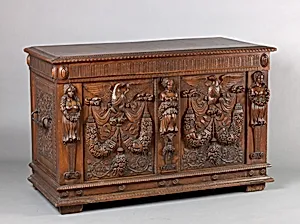
Credence (chest)
Unknown Artist
mid-19th century
Medium
Walnut
Dimensions
H. 68 cm, W. 36.7 cm, D. 63 cm
Classification
Woodwork-Furniture
Culture
French
Department
Robert Lehman Collection
Museum
Metropolitan Museum of Art, New York, NY
Credit
Robert Lehman Collection, 1975
Accession Number
1975.1.2019
Rights
Public Domain
Tags
Art Historical Context
This elegant *Credence (chest)*, crafted in walnut by an unknown French artisan in the mid-19th, exemplifies the refined woodwork of its era. Standing at 68 cm high, with a narrow width of 36.7 cm and depth of 63 cm, it served as a compact sideboard or cupboard, traditionally used to display silverware, hold serving dishes, or store valuables in dining spaces. The choice of walnut—a durable, richly grained hardwood prized for its warm tones and polishability—highlights the technical mastery of French cabinetmakers, who often veneered or carved it to accentuate natural beauty and intricate details. Adorned with eagle motifs (as suggested by its tags), the chest evokes the imperial symbolism popular during France's Second Empire under Napoleon III, when such birds represented power and grandeur. Though the artist remains anonymous, this piece reflects the period's blend of historicism and opulence, drawing on Renaissance precedents for credence furniture while adapting them to 19th-century tastes. Acquired for the Robert Lehman Collection in 1975 and now housed in the Metropolitan Museum of Art's Woodwork-Furniture department, it offers a glimpse into bourgeois domestic life, where functional objects doubled as statements of cultural prestige. Visitors will appreciate its timeless craftsmanship and subtle nod to French national pride.