
Crew
1865
Medium
Etching
Dimensions
Sheet: 10 1/16 × 13 3/8 in. (25.5 × 34 cm) Plate: 5 5/16 × 7 7/8 in. (13.5 × 20 cm)
Classification
Prints
Department
Drawings and Prints
Museum
Metropolitan Museum of Art, New York, NY
Credit
Harris Brisbane Dick Fund, 1927
Accession Number
27.10.57
Rights
Public Domain
Tags
Art Historical Context
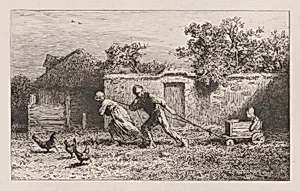
Charles Jacque’s 1865 etching *Crew* offers a charming glimpse into everyday rural life. The compact plate captures a lively scene populated by men, women, and children gathered around carts, with chickens scattered at their feet. Through delicate line work, Jacque conveys both the bustle of activity and the quiet rhythms of the countryside, inviting viewers to linger over the interactions between people and animals. Etching was a favored medium for 19th-century artists seeking fine detail and tonal subtlety. By drawing through a wax ground on a metal plate and then immersing it in acid, Jacque could achieve the crisp textures of feathers, fabric, and wooden carts seen here. The resulting print, measuring just over five by seven inches, allowed such intimate views to reach a broad audience through multiple impressions. Acquired by the Metropolitan Museum in 1927 through the Harris Brisbane Dick Fund, this work preserves a moment of communal rural existence. Its modest scale and precise observation continue to reward close looking, revealing the artist’s skill at distilling the energy of a farmyard into a single, engaging composition.
About the Artist
Charles Jacque · 1813–1894
Charles-Émile Jacque (1813–1894) was a pioneering French painter, engraver, and illustrator whose career bridged the worlds of printmaking and pastoral painting. Born in Paris amid a difficult childhood, he apprenticed at age seventeen to a map engraver, mastering drypoint technique and producing his first etching in 1830—a copy of a head after Rembrandt. After serving seven years in the French Ar...