
Spring
1864
Medium
Etching
Dimensions
Sheet: 18 1/2 in. × 13 in. (47 × 33 cm) Plate: 7 1/2 × 5 7/8 in. (19 × 15 cm)
Classification
Prints
Department
Drawings and Prints
Museum
Metropolitan Museum of Art, New York, NY
Credit
Harris Brisbane Dick Fund, 1927
Accession Number
27.10.31
Rights
Public Domain
Tags
Art Historical Context
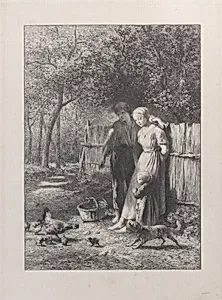
**Spring** (1864) is a delicate etching by French artist Charles Jacque, a member of the Barbizon, known for his intimate depictions of rural life and animals. Created during the mid-19th century, when Realism was challenging academic art, Jacque captures the vitality of spring on the French countryside. This print, from the Metropolitan Museum of's Drawings and Prints collection, reflects the era's fascination with pastoral harmony amid France's industrial changes. Measuring a modest plate size of 7½ × 5⅞ inches, the etching showcases Jacque's mastery of the medium. Etching allowed for intricate lines and textures—acid biting into a metal plate to create fine details like feathers on chickens or fur on dogs. The scene likely bustles with women, men, and children tending to farm animals, evoking a timeless cycle of renewal and labor. These elements highlight Jacque's animalier expertise, blending human figures with livestock in warm, naturalistic vignettes. Acquired through the Harris Brisbane Dick Fund in 1927, *Spring* invites visitors to appreciate 19th-century printmaking's accessibility, bringing countryside serenity into urban galleries. It's a charming reminder of art's power to celebrate everyday joys. (198 words)
About the Artist
Charles Jacque · 1813–1894
Charles-Émile Jacque (1813–1894) was a pioneering French painter, engraver, and illustrator whose career bridged the worlds of printmaking and pastoral painting. Born in Paris amid a difficult childhood, he apprenticed at age seventeen to a map engraver, mastering drypoint technique and producing his first etching in 1830—a copy of a head after Rembrandt. After serving seven years in the French Ar...