
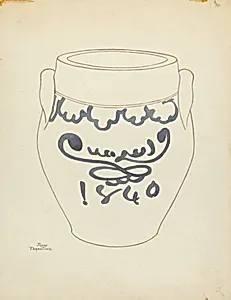
Crock
c. 1953
Medium
watercolor and graphite on paperboard
Dimensions
overall: 29.3 x 22.7 cm (11 9/16 x 8 15/16 in.) Original IAD Object: 9" high; 7 1/2" in diameter
Classification
Index of American Design
Department
CG-W
Museum
National Gallery of Art, Washington, D.C.
Credit
Index of American Design
Accession Number
1943.8.7917
Rights
Public Domain
Art Historical Context
**Crock**, a delicate watercolor and graphite rendering by John Tarantino from around 1953, captures the humble elegance of a traditional American crock—a sturdy earthenware vessel measuring 9 inches high and 7½ inches in diameter. Housed in the National Gallery of Art's of American Design collection, artwork faithfully depicts the pot's simple, functional form, likely used for storing preserves, butter, or grains in early American households. Tarantino's precise lines in graphite outline the crock's rounded body and subtle contours, while soft watercolors evoke its earthy tones, highlighting everyday objects as emblems of cultural heritage. Created as part of the Index of American Design—a Works Progress Administration (WPA) project from the 1930s and 1940s—this piece exemplifies a national effort to document and celebrate American folk art amid the Great Depression. Artists like Tarantino produced thousands of such meticulous studies of decorative arts, crafts, and design, preserving regional traditions before they faded. Rendered on paperboard at 29.3 x 22.7 cm, the work blends artistic skill with documentary accuracy, bridging fine art and historical record. Through its unassuming subject, **Crock** reminds us of the ingenuity of American potters and the vital role of utilitarian wares in daily life, inviting visitors to appreciate the beauty in the ordinary.
About the Artist
John Tarantino · 1855–present
John Tarantino was an American artist active from around 1935 to 1953, best known for his meticulous contributions to the Index of American Design, a Federal Art Project under the Works Progress Administration (WPA). This ambitious initiative commissioned artists across the United States to create precise renderings of everyday folk art objects, preserving the nation's vernacular design heritage a...