
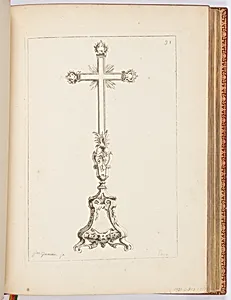
Croix d'autels
Classification
Department
Smithsonian Collection
Museum
Smithsonian American Art Museum
Credit
Purchased for the Museum by the Advisory Council
Accession Number
1921-6-313-31
Rights
Public Domain
About this artwork
Research in Progress
Art Historical Context
**Croix d'Autels** *Pierre Germain (French, 1703–1783), 1748* Print; Smithsonian American Art Museum Germain, a distinguished French engraver and gold active during the lavish Rococo period, created *Croix d'Autels* ("Altar Crosses") 1748. As the son of a prominent royal goldsmith, Germain mastered intricate printmaking techniques, producing detailed designs that served as models for artisans crafting religious furnishings. This print exemplifies his expertise in translating opulent three-dimensional objects into precise, two-dimensional engravings, blending technical precision with the era's playful elegance. Set against the backdrop of Louis XV's France, where the Catholic Church commissioned sumptuous altar decorations, Germain's work disseminated sophisticated motifs—scrolling vines, radiant halos, and symbolic crosses—to workshops across Europe. Prints like this were vital tools for standardizing high-style religious art, influencing goldsmiths and silversmiths in creating processional crosses for altars and ceremonies. Though the exact medium awaits further research, its classification as a print underscores the democratic power of engraving to share elite designs widely. Acquired by the Smithsonian American Art Museum through its Advisory Council, *Croix d'Autels* invites us to appreciate how 18th-century innovation in printmaking elevated devotional art, merging faith, craftsmanship, and the exuberant spirit of Rococo ornamentation. A window into Enlightenment-era creativity!