
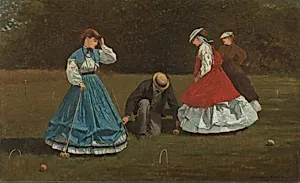
Croquet Scene
1866
Medium
Oil on canvas
Dimensions
40.3 × 66.2 cm (15 7/8 × 26 1/16 in.)
Classification
painting
Department
Arts of the Americas
Museum
Art Institute of Chicago
Accession Number
44018
Rights
Public Domain
About this artwork
One of America’s foremost painters, Winslow Homer began his career as an illustrator during the Civil War. In the late 1860s, he turned his acute observational and technical skills toward oil painting, depicting figures bathed in sunlight out-of-doors. These early paintings, often executed in series, feature scenes of upper-class leisure pursuits—in this case, women and men competing with one another in the popular sport of croquet, which had recently been introduced to the United States from th...
Art Historical Context
Winslow Homer’s *Croquet Scene* captures a lighthearted moment of leisure in post-Civil War America. Painted in 1866, the work depicts fashionable young women and men engaged in the recently imported English game of croquet, an activity that quickly became a symbol of refined social interaction and courtship among the rising middle class. Homer, who began his career as an illustrator, brings a keen eye for everyday American life to this early oil painting, transforming an ordinary pastime into a quiet commentary on changing social customs. Measuring just over 15 by 26 inches, the modest canvas invites close viewing, allowing viewers to appreciate Homer’s precise rendering of crisp white dresses, wooden mallets, and dappled sunlight. The medium of oil on canvas enabled him to achieve subtle tonal shifts and a sense of outdoor atmosphere while retaining the crisp outlines of his graphic training. Today in the Art Institute of Chicago’s collection, *Croquet Scene* stands as an early example of Homer’s lifelong interest in themes of recreation and human connection, offering modern visitors a charming glimpse of nineteenth-century American leisure.
About the Artist
Winslow Homer · 1836–1910
Winslow Homer (1836-1910) was one of America's greatest painters and a preeminent figure in 19th-century American art. Largely self-taught, Homer began his career as a commercial illustrator and Civil War correspondent for Harper's Weekly before becoming renowned for his powerful marine subjects and landscape paintings. His mastery of both oil and watercolor, combined with his uncompromising reali...