
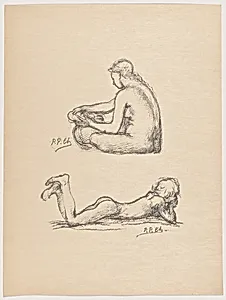
Croquis (Sketches)
Medium
lithograph in dark gray on heavy japan paper
Dimensions
sheet: 37.1 x 28.1 cm (14 5/8 x 11 1/16 in.)
Classification
Department
CG-E
Museum
National Gallery of Art, Washington, D.C.
Credit
Virginia and Ira Jackson Collection, gift in memory of Virginia H. Jackson
Accession Number
1996.151.25
Rights
Public Domain
Art Historical Context
Pierre Puvis de Chavannes, a leading French Symbolist painter of the late 19th century, created *Croquis (Sketches)* in 1895, near the end of his illustrious career. Renowned for his large-scale murals adorning public buildings in Paris—such as the Panthéon and the Sorbonne—Puvis blended classical idealism with dreamlike simplicity, influencing artists like Gauguin and Seurat. This intimate lithograph captures his preparatory process, offering visitors a rare glimpse into the mind of a master who favored ethereal figures and allegorical themes drawn from mythology and nature. Printed in dark gray ink on luxurious heavy japan paper—a fine, absorbent Asian import prized by printmakers for its texture and durability—the work measures 37.1 x 28.1 cm. Lithography, Puvis's chosen medium here, allowed precise tonal gradations through greasy crayon on stone, enabling editioned reproductions of his fluid, gestural lines. These sketches likely served as studies for larger compositions, showcasing his economical style that stripped forms to their poetic essence, evoking quiet introspection amid Symbolism's rise. Generously gifted to the National Gallery of Art from the Virginia and Ira Jackson Collection in memory of Virginia H. Jackson, *Croquis* highlights Puvis's enduring legacy. Displayed in the Prints department, it invites contemplation of how fleeting ideas on paper blossomed into monumental art, bridging private creativity and public grandeur.
About the Artist
Pierre Puvis de Chavannes · 1824–1898
Pierre Puvis de Chavannes (1824–1898) was a French painter who became the foremost muralist of nineteenth-century France and a crucial bridge between academic tradition and modernism. Born in Lyon to a prosperous family, he studied briefly with Henri Scheffer and Thomas Couture in Paris and traveled to Italy, where the frescoes of the Italian Renaissance made a lasting impression on his artistic v...