
Cross
Unknown Artist
11th century
Medium
Steatite
Dimensions
Overall: 3 7/16 x 2 1/16 x 3/8 in. (8.7 x 5.2 x 0.9 cm)
Classification
Steatites
Culture
Byzantine
Department
Medieval Art
Museum
Metropolitan Museum of Art, New York, NY
Credit
Gift of Miriam N. Rosen, 2002
Accession Number
2002.483.4
Rights
Public Domain
Tags
Art Historical Context
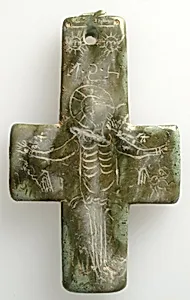
This 11th-century Byzantine steatite cross, measuring a compact 3 7/16 x 2 1/16 x 3/8 inches, exemplifies the portable devotional art cherished in the medieval Christian world. Carved from soapstone—a soft, fine-grained material ideal for intricate relief work—the cross likely depicts Christ crucified, a powerful symbol of faith and redemption central to Byzantine spirituality. Its small size suggests it was worn as a pectoral ornament by clergy or laity, offering personal protection and piety on the go. In the Byzantine Empire, spanning the 11th century amid theological debates and imperial grandeur, such crosses bridged imperial workshops and monastic traditions. Steatite's affordability and carvability allowed for detailed figures and inscriptions, though this example's precise motifs remain subtle in their preserved form. Produced during a golden age of Orthodox iconography, it reflects the era's emphasis on sacred imagery as a conduit to the divine. Today, gifted to the Metropolitan Museum of Art in 2002, this artifact invites us to touch the tangible faith of Byzantium—where even a modest stone cross embodied eternal hope.