
Cross Bow
1935/1942
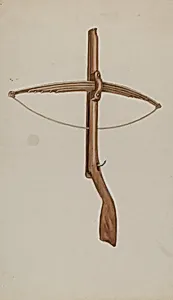
Medium
watercolor, graphite, and heightening on paper
Dimensions
overall: 35.2 x 20.3 cm (13 7/8 x 8 in.)
Classification
Index of American Design
Department
CG-W
Museum
National Gallery of Art, Washington, D.C.
Credit
Index of American Design
Accession Number
1943.8.9598
Rights
Public Domain
Art Historical Context
"Cross Bow," a meticulous rendering from the Index of American Design, captures intricate details of a traditional crossbow, an early mechanical weapon with roots in medieval Europe but adapted in American craftsmanship. Created between 1935 and 1942 by an anonymous American of the 20th century this work measures 35.2 x 20.3 cm and employs watercolor, graphite, andening on paper. The heightening technique—using white gouache or metallic pigments—adds luminous depth, making the wood grain, metal fittings, and taut string pop with realistic vibrancy, as if inviting viewers to grasp its historical heft. Part of a groundbreaking Federal Art Project under the Works Progress Administration (WPA) during the Great Depression, the Index aimed to document America's folk and decorative arts through over 15,000 such watercolor studies. Housed in the National Gallery of Art's CG-W department, this piece highlights the crossbow's place in early American material culture, possibly evoking frontier ingenuity or colonial hunting tools. Its artistic significance lies in preserving endangered artifacts via precise, colorful interpretations, bridging art and history for future generations. Today, "Cross Bow" reminds us of the WPA's role in employing artists while safeguarding cultural heritage, offering a window into the practical beauty of everyday American objects from centuries past.
About the Artist
American 20th Century · 1900–1999
"American 20th Century" is the designation used by major institutions such as the National Gallery of Art (NGA) for anonymous and unidentified artists active in the United States during the twentieth century. The artist's personal identity, early life, and training remain undocumented, reflecting the challenges of attribution for unattributed works from this era. No specific teachers, art schools,...