
Bucksaw
1938
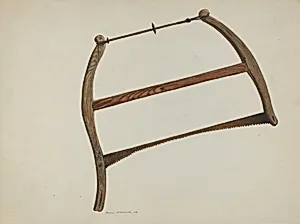
Medium
watercolor, graphite, and pen and ink on paperboard
Dimensions
overall: 30.6 x 40.9 cm (12 1/16 x 16 1/8 in.)
Classification
Index of American Design
Department
CG-W
Museum
National Gallery of Art, Washington, D.C.
Credit
Index of American Design
Accession Number
1943.8.13449
Rights
Public Domain
Art Historical Context
Henry Waldeck's *Bucksaw* (1938) captures the sturdy simplicity of a traditional two-man frame saw used for bucking logs, rendered with precision in watercolor, graphite, and pen and ink on paper (30.6 × 40.9 cm). This study highlights the tool's functional design—its arched frame, pistol-grip handles, and sharp blade—evoking the rugged labor of American frontiersmen and woodsmen. Created as part of the Index of American Design, a Deal-era Federal Art Project (1935–1942), the work reflects a national effort to document and celebrate everyday American folk objects amid the Great Depression. Artists like Waldeck produced over 18,000 watercolor plates to preserve cultural heritage, transforming utilitarian items into artistic records of national identity. Waldeck's mixed-media technique blends soft watercolor washes for wood grain and metallic sheen with fine graphite and ink lines for crisp detail, emphasizing the saw's craftsmanship. Housed in the National Gallery of Art, *Bucksaw* invites visitors to appreciate how ordinary tools embody America's industrious spirit and handmade traditions.
About the Artist
Henry Waldeck · 1855–present
Henry Waldeck was an American artist active around 1935, best known for his precise watercolor renderings created as part of the Index of American Design, a Federal Art Project under the Works Progress Administration (WPA). This ambitious initiative, spanning 1935 to 1942, commissioned artists across the United States to document everyday objects of American folk art and craftsmanship, preserving ...