
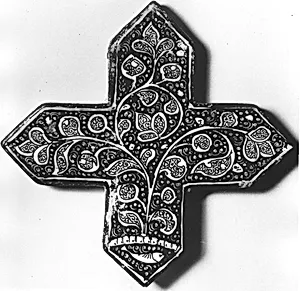
Cross-Shaped Tile
Unknown Artist
13th century
Medium
Stonepaste; luster-painted on opaque white glaze under transparent glaze
Dimensions
H. 8 in. (20.3 cm) W. 8 in. (20.3 cm) Wt. (whole group) 51 lbs (23 kg)
Classification
Ceramics-Tiles
Department
Islamic Art
Museum
Metropolitan Museum of Art, New York, NY
Credit
H.O. Havemeyer Collection, Gift of Horace Havemeyer, 1941
Accession Number
41.165.34
Rights
Public Domain
Tags
Art Historical Context
This exquisite **Cross-Shaped Tile** the 13th century the pinnacle of Islamic ceramic artistry, likely produced in regions like Syria or Iran where stonepaste technology flourished. Crafted from stonepaste—a composite of quartz, clay, and glass frit for a durable, porcelain-like body—the tile measures a modest 8 x 8 inches (20.3 x 20.3 cm). Its surface features luster-painting on an opaque white glaze, with a transparent glaze that creates a shimmering, metallic iridescence. Delicate leaf motifs, hinted at in its design, evoke the natural world, a common theme in Islamic decoration symbolizing paradise gardens. Lusterware like this was a guarded technical marvel, involving firing the tile multiple times and applying metallic oxides that "breathe" color through the glaze, producing jewel-like effects in candlelight. These tiles adorned mosques, palaces, and mihrabs, transforming architecture into luminous art. The cross shape may reflect innovative architectural use, perhaps in revetments or friezes, blending form and function. Part of a larger group weighing 51 lbs (23 kg), this tile entered the Metropolitan Museum of Art in 1941 via the H.O. Havemeyer Collection. It invites visitors to marvel at medieval Islamic ingenuity, where everyday materials became portals to splendor.