
Star-Shaped Tile
Unknown Artist
1260–70
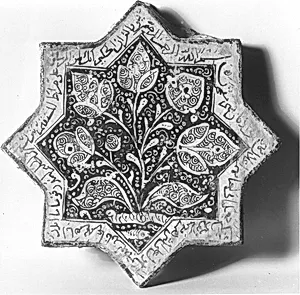
Medium
Stonepaste; luster-painted on opaque white glaze under transparent glaze
Dimensions
H. 8 in. (20.3 cm) W. 8 in. (20.3 cm) Wt. (whole group): 51 lbs. (23.1 kg)
Classification
Ceramics-Tiles
Department
Islamic Art
Museum
Metropolitan Museum of Art, New York, NY
Credit
H.O. Havemeyer Collection, Gift of Horace Havemeyer, 1941
Accession Number
41.165.8
Rights
Public Domain
Tags
Art Historical Context
Behold the **Star-Shaped Tile**, radiant gem from the Islamic world crafted between 1260 and 1270. This eight-inch square tile, shaped like a multifaceted star, exemplifies the exquisite ceramics of medieval Syria or Iran. Made of stonepaste—a innovative composite of quartz frit, clay, and glass was luster-painted with metallic oxides over an opaque white glaze, fired under a transparent topcoat. This technique produced a shimmering, iridescent glow catches the light like stars in the night sky, evoking the celestial motifs beloved in Islamic art. Lusterware like this reached its zenith in the 13th century, blending technical mastery with poetic beauty. Artisans fired the tiles multiple times to embed gold and silver-like effects, mimicking precious metals without their weight. Part of a larger group weighing over 50 pounds—likely from a architectural panel or mihrab—this tile adorned mosques, palaces, or madrasas, where geometric stars symbolized the infinite order of the universe in Islamic cosmology. Today, gifted to the Metropolitan Museum of Art in 1941 from the H.O. Havemeyer Collection, it invites us to marvel at the anonymous artist's skill. In the Department of Islamic Art, it whispers of a golden age when tiles transformed walls into luminous heavens, bridging craft and spirituality. (198 words)