
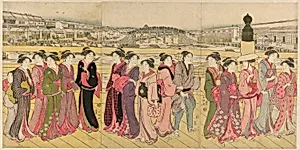
Crossing Nihonbashi Bridge
c. 1790
Medium
Color woodblock print; oban triptych
Dimensions
Each: 36.7 × 25.1 cm (14 7/16 × 9 7/8 in.)
Classification
woodblock print
Department
Arts of Asia
Museum
Art Institute of Chicago
Accession Number
22927
Rights
Public Domain
Art Historical Context
Step onto the vibrant streets of Edo-period Japan with Katsukawa Shunchô'sCrossing Nihonbashi Bridge* (c. 1790), a stunning color woodblock print triptych from the ukiyo-e tradition. Thisan-sized work—three panels each measuring about 37 × 25 cm—captures the lively bustle of pedestrians traversing the iconic Nihonbashi Bridge, vital hub of commerce and daily life in central Edo (modern Tokyo). Shunchô, a master of the Katsukawa school, excelled in depicting elegant figures and urban scenes, blending graceful bijin-ga (images of beautiful women) with dynamic genre moments. The triptych format allows for an expansive panoramic view, immersing viewers in the throng of merchants, samurai, and courtesans amid the bridge's wooden arches and river traffic below. Printed using intricate woodblock techniques—carved blocks inked in multiple colors and layered by hand—this medium democratized art, making affordable beauty accessible to everyday collectors during Japan's prosperous Edo era. Housed in the Art Institute of Chicago's Arts of Asia department, this print exemplifies ukiyo-e's "floating world" ethos, celebrating fleeting pleasures and urban energy. It offers a vivid snapshot of 18th-century Japanese society, where bridges like Nihonbashi symbolized connectivity and cultural vibrancy.
About the Artist
Katsukawa Shunchô · 1780–1801
Katsukawa Shunchō was a Japanese designer of ukiyo-e woodblock prints active from approximately 1780 to 1795, one of the most graceful practitioners of the art of bijinga — pictures of beautiful women. He trained in the studio of Katsukawa Shunshō, the founding master of the Katsukawa School, whose pupils also included the young Hokusai. Shunshō's school was primarily known for realistic portraits...