
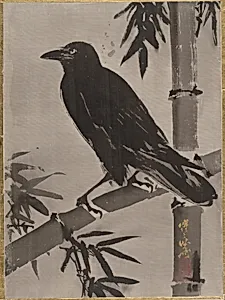
竹に鴉図|Crow on a Bamboo Branch
ca. 1887
Medium
Album leaf; ink and color on silk
Dimensions
14 1/4 x 10 1/2 in. (36.2 x 26.7 cm)
Classification
Paintings
Culture & Period
Japan · Meiji period (1868–1912)
Department
Asian Art
Museum
Metropolitan Museum of Art, New York, NY
Credit
Charles Stewart Smith Collection, Gift of Mrs. Charles Stewart Smith, Charles Stewart Smith Jr., and Howard Caswell Smith, in memory of Charles Stewart Smith, 1914
Accession Number
14.76.61.11
Rights
Public Domain
Tags
Art Historical Context
In the bustling Meiji period (1868–1912), as Japan rapidly modernized while cherishing its artistic traditions, Kawanabe Kyōsai (1831–1889) createdCrow on a Bamboo Branch around 1887. This intimate album leaf, measuring just 14¼ × 10½ inches, exemplifies Kyōsai's dynamic style, blending ukiyo-e influences with, expressive brushwork. Known for his satirical and fantastical works, Kyōsai often infused everyday subjects like birds and plants with vitality and humor, bridging Edo-period whimsy with Meiji-era innovation. Rendered in ink and color on silk—a luxurious medium prized for its luminous sheen and ability to hold delicate pigments—the painting captures a crow perched alertly on a slender bamboo stalk. Album leaves like this were designed for private albums, allowing collectors to savor close-up details of nature's elegance. Bamboo, a symbol of resilience in Japanese culture, sways gracefully, while the crow's sharp gaze adds a touch of intrigue, evoking themes of vigilance and the wild. Now housed in the Metropolitan Museum of Art's Asian Art Department, this piece from the Charles Stewart Smith Collection (gifted in 1914) showcases Kyōsai's mastery of form and movement, inviting visitors to appreciate the poetic harmony of flora and fauna in Japan's artistic heritage.
About the Artist
Kawanabe Kyōsai 河鍋暁斎 (Japanese) · 1831 –1889
Japanese, 1831–1889