
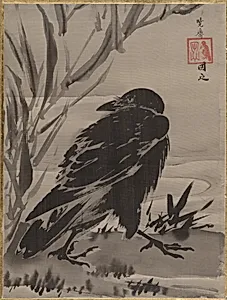
水辺に鴉図|Crow and Reeds by a Stream
ca. 1887
Medium
Album leaf; ink and color on silk
Dimensions
14 1/4 x 10 3/4 in. (36.2 x 27.3 cm)
Classification
Paintings
Culture & Period
Japan · Meiji period (1868–1912)
Department
Asian Art
Museum
Metropolitan Museum of Art, New York, NY
Credit
Charles Stewart Smith Collection, Gift of Mrs. Charles Stewart Smith, Charles Stewart Smith Jr., and Howard Caswell Smith, in memory of Charles Stewart Smith, 1914
Accession Number
14.76.61.7
Rights
Public Domain
Tags
Art Historical Context
Kawanabe Kyōsai's *Crow and Reeds by Stream* (水辺に鴉図), created around 1887, captures a moment of poised tension in nature on a delicate album leaf of ink and color on silk Measuring just 14¼ × 10¾ inches, this intimate format invites close contemplation, typical of Japanese album paintings meant for personal collections or scholarly exchange. The composition features a solitary crow perched amid swaying reeds by a stream, rendered with Kyōsai's signature bold, expressive brushwork that blends whimsy and precision. A leading figure of the Meiji period (1868–1912), Kyōsai was renowned for his dynamic fusion of traditional ukiyo-e and literati painting styles, often infused with humor and satire amid Japan's rapid Westernization. Crows, symbols of intelligence and mischief in Japanese folklore, hold a special place in his oeuvre, appearing frequently as lively protagonists. His masterful use of ink—fluid washes for the reeds' subtle textures alongside vivid color accents—highlights the silk's luminous sheen, showcasing techniques rooted in centuries-old East Asian traditions while reflecting Meiji-era artistic innovation. This work, from the Metropolitan Museum of Art's Asian Art collection (Charles Stewart Smith Collection, 1914), exemplifies Kyōsai's enduring legacy as Japan's "last great ukiyo-e master," bridging old and new worlds through nature's quiet drama.
About the Artist
Kawanabe Kyōsai 河鍋暁斎 (Japanese) · 1831 –1889
Japanese, 1831–1889