
Crowning Homer
n.d.
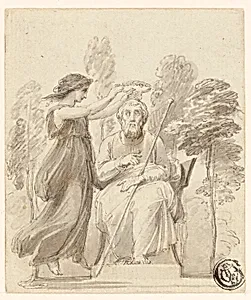
Medium
Pen and gray ink with brush and gray wash, on gray wove paper, laid down on board
Dimensions
8.7 × 7.4 cm (3 7/16 × 2 15/16 in.)
Classification
ink or chalk wash
Department
Prints and Drawings
Museum
Art Institute of Chicago
Accession Number
83424
Rights
Public Domain
Art Historical Context
Thomas Stothard's *Crowning Homer* is delicate preparatory drawing that captures the neoclassical reverence for ancient poetry. The British artist (1755–1834), renowned for his elegant illustrations and history paintings, frequently drew inspiration from classical mythology and literature. Here, the title evokes a timeless tribute to Homer, the legendary Greek epic poet, likely shown being crowned in a moment of poetic glory—perhaps by muses or admirers—reflecting the 18th- and 19th-century fascination with antiquity amid the Romantic era's classical revival. Executed in pen and gray ink with brush and gray wash on gray wove paper, this intimate work (just 8.7 × 7.4 cm) showcases Stothard's mastery of monochromatic techniques. The gray wash adds subtle tonal depth and modeling, creating a soft, atmospheric effect ideal for sketches meant to explore composition before larger oils or engravings. Laid down on board for preservation, it highlights the technical precision of British draftsmanship, where ink washes mimicked the luminosity of oil painting. Housed in the Art Institute of Chicago's Prints and Drawings department, this undated gem offers a window into Stothard's prolific output for books and prints, blending historical homage with artistic virtuosity. Visitors will appreciate its small scale, inviting close inspection of fine lines that breathe life into legend.
About the Artist
Thomas Stothard · 1755–1834
Thomas Stothard RA (1755–1834) was born on 17 August 1755 at the Black Horse Inn in London's Long Acre, the son of a prosperous publican originally from Stutton near Tadcaster. A delicate child, he was sent at age five to relatives in Yorkshire, attending schools in Acomb, Tadcaster, and later Ilford, Essex, where he honed his drawing skills by copying prints. Following his father's death in 1770,...