
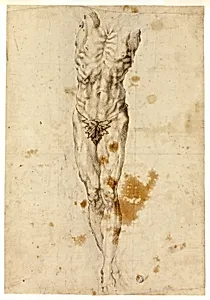
Crucified Christ or Marsyas
Medium
Pen and brown ink, heightened with lead white (partially oxidized), on cream laid paper, squared in black chalk, laid down on ivory wove paper
Dimensions
36.9 × 25.6 cm (14 9/16 × 10 1/8 in.)
Classification
pen and ink drawings
Department
Prints and Drawings
Museum
Art Institute of Chicago
Accession Number
82324
Rights
Public Domain
Art Historical Context
This poignant drawing, titled *Crucified Christ or Marsyas* and attributed to a follower of Michelangelo Buonarroti, dates to around 1585–95. Created in the late Mannerist period, it captures the dramatic musculature and emotional intensity characteristic of Michelangelo's style, even decades after the master's death in 1564. The ambiguous subject—possibly the crucified Christ or the mythological figure Marsyas, flayed alive by Apollo—reflects the Renaissance fascination with blending Christian iconography and classical myths, evoking themes of suffering and transcendence. Executed in pen and brown ink heightened with lead white (now partially oxidized) on cream laid paper, the work measures 36.9 × 25.6 cm. The white heightening adds luminous modeling to the torsion of the figure's body, while black chalk squaring suggests it was prepared for transfer to another surface, common in workshops for frescoes or paintings. Laid down on ivory wove paper for preservation, this technique exemplifies the meticulous draftsmanship of Italian draftsmen emulating Michelangelo's heroic nudes. Housed in the Art Institute of Chicago's Prints and Drawings Department, the drawing highlights Michelangelo's lasting influence on European art. Its dual interpretation invites visitors to ponder how Renaissance artists reinterpreted sacred and pagan narratives, bridging antiquity and faith in a single, powerful form.