
Crucifix
Unknown Artist
ca. 1200–1220
Medium
Wood with polychromy
Dimensions
Overall (Christ): 75 5/8 x 76 1/4 x 11 1/4 in. (192.1 x 193.7 x 28.6 cm) Cross: 89 1/8 x 80 1/2 x 1 in. (226.4 x 204.5 x 2.5 cm)
Classification
Sculpture-Wood
Culture
North Italian
Department
Medieval Art
Museum
Metropolitan Museum of Art, New York, NY
Credit
Fletcher Fund, 1947
Accession Number
47.100.54
Rights
Public Domain
Tags
Art Historical Context
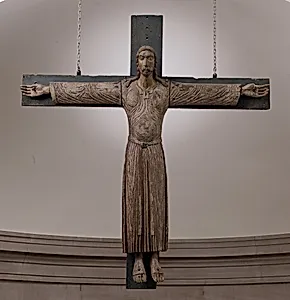
This imposing *Crucifix*, crafted by an unknown North Italian artist around 1200–1220, stands as a powerful testament to medieval Christian devotion. Carved from wood and enhanced with polychromy—vibrant paints and gilding that would have originally made the figure gleam under church candlelight—the sculpture depicts Christ on the cross in a dramatic, life-sized scale. Measuring nearly six feet tall for the Christ alone, with the full cross exceeding seven feet, it likely served as a focal point in a monastery or cathedral, inspiring awe and prayer among worshippers during the Romanesque era's transition to Gothic styles. The artwork's artistic significance lies in its masterful wood carving techniques, where the sculptor's skill captures Christ's elongated body, serene yet suffering expression, and flowing drapery, hallmarks of North Italian medieval sculpture. Polychromy not only added realism and emotional intensity but also elevated the crucifix as a multisensory devotional aid, drawing the faithful into the Passion narrative. Such large-scale crucifixes were central to liturgical life, often processed during Holy Week or venerated at altars. Today, housed in The Metropolitan Museum of Art's Medieval Art Department (Fletcher Fund, 1947), this survivor of centuries offers a window into 13th-century piety, reminding us how art bridged the earthly and divine in medieval Italy.