
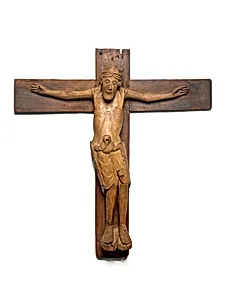
Kruzifix
Ende 12. Jahrhundert
Medium
Erlenholz mit alten Fassungsresten
Dimensions
Korpus: 88,5 x 78 cm
Classification
Viernagelkruzifix
Department
Belvedere Collection
Museum
Belvedere
Credit
Belvedere, Vienna
Accession Number
5986
Rights
Public Domain
About this artwork
Die Holzfigur ist das älteste Werk in der Sammlung des Belvedere. Sie folgt dem sogenannten Viernagel-Schema. Wie in der romanischen Kunst üblich, sind die Füße Christi nebeneinander angeordnet und so wie auch die Hände mit jeweils einem Nagel an das Kreuz geschlagen. Die Skulptur zeigt Christus als Triumphator über den Tod. Er trägt eine Krone, Körper und Gesicht sind von keinerlei Schmerzen gezeichnet. Im Laufe des 13. Jahrhunderts wird dieses Motiv von Darstellungen des qualvoll am Kreuz Ster...
Art Historical Context
This remarkable crucifix, carved from alder wood by an anonymous Tyrolean sculptor at the end of the twelfth century, stands as the oldest work in the Belvedere’s collection. Measuring just under ninety centimeters in height, the figure follows the traditional Viernagel, or four-nail, type common in Romanesque art. Christ’s hands and feet are each pierced by a separate nail, with his feet placed side by side rather than overlapping—an arrangement that emphasizes solemn dignity over physical torment. The sculpture presents Christ not as a suffering victim but as a triumphant ruler over death. He wears a crown, his upright posture and serene expression conveying victory and divine authority. Traces of the original polychromy still cling to the wood, hinting at the vivid colors that once animated the figure for medieval viewers. By the thirteenth century, this serene image would give way to more expressive depictions of Christ’s agony, intended to stir compassion and personal devotion. As a rare survivor of early medieval woodcarving, the Kruzifix offers visitors a direct encounter with the spiritual imagination of the Romanesque era.