
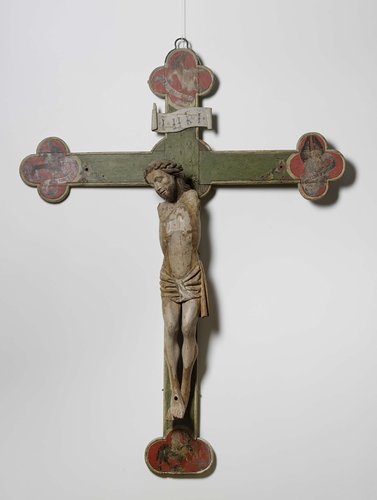
Crucifix
c. 1470 - c. 1490
Medium
walnut (corpus) and fruit wood (?) (cross) with polychromy
Dimensions
18; 151; 12.5; 116; 91; 2.5
Rights
Public Domain
About this artwork
inscription, on the banderole on the right quatrefoil: illegible
Art Historical Context
This striking Crucifix, crafted anonymously around 1470–1490, exemplifies late medieval devotional art from Northern Europe. Carved from walnut for the finely detailed corpus—the sculpted body of Christ—and possibly fruitwood for the cross, it stands at an imposing 151 cm tall, making it suitable for prominent display in a church or chapel. The thin profile (just 2.5 cm deep) highlights its sculptural focus, designed to be viewed from multiple angles during processions or worship. Polychromy, the original layering of paint and gilding, once brought vivid life to the wood, emphasizing Christ's suffering through realistic anatomy, wounds, and expression—a hallmark of the period's emotional piety. Though traces may remain, time has faded much of this color, revealing the wood's natural grain. A banderole on the right quatrefoil bears an illegible inscription, likely a scriptural quote or prayer, underscoring its liturgical purpose. In an era of religious fervor before the Reformation, such crucifixes were central to personal and communal devotion, inviting contemplation of sacrifice and redemption. This piece captures the Gothic-to-Renaissance transition, blending expressive realism with spiritual intensity, offering visitors a tangible link to 15th-century faith.
About the Artist
anonymous
In the vast tapestry of art history, "Anonymous" stands not as a singular individual but as a collective designation for countless unidentified creators whose works have endured across millennia. These artists, spanning prehistoric cave painters to medieval illuminators and folk craftsmen, produced the foundational layers of human visual culture. Prior to the Renaissance, when individual fame emer...