
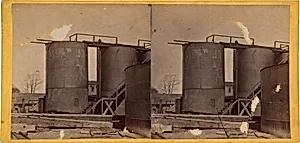
Crude Oil Tanks, Clark & Sumner, Standard Petroleum Refinery, Pittsburg, Pennsylvania
c. 1865
Medium
stereoscopic albumen prints
Dimensions
image/sheet (each): 7.7 × 7.9 cm (3 1/16 × 3 1/8 in.) mount: 8.1 × 17 cm (3 3/16 × 6 11/16 in.)
Classification
Photograph
Department
CPH
Museum
National Gallery of Art, Washington, D.C.
Credit
Pepita Milmore Memorial Fund
Accession Number
2017.93.12
Rights
Public Domain
Art Historical Context
This stereoscopic photograph by Thomas H. Johnson captures the industrial landscape of the Standard Petroleum Refinery in Pittsburgh, Pennsylvania, around 1865. The paired albumen prints depict rows of crude oil tanks at the Clark & Sumner facility, offering a rare early glimpse of America’s emerging oil industry just a few years after the nation’s first commercial oil well was drilled in nearby Titusville. Johnson’s use of the stereoscopic format was especially effective for conveying the scale and density of these massive storage tanks. When viewed through a stereoscope, the images produce a striking three-dimensional effect that allowed nineteenth-century audiences to experience the refinery’s vastness from the comfort of their parlors. Such views helped popularize photography as both a documentary tool and a form of virtual travel during the height of the Industrial Revolution. Today the work stands as an important record of Pennsylvania’s pivotal role in the birth of the petroleum age. Its crisp detail and compositional clarity reflect the technical sophistication of albumen printing at a moment when photography was rapidly documenting the transformation of the American landscape.
About the Artist
Thomas H. Johnson · 1860–1870
Thomas H. Johnson was an American artist active in the latter half of the nineteenth century. Working during a period of considerable vitality in American art — when landscape painting, genre scenes, and printmaking were all flourishing — Johnson contributed to a visual culture that was expanding rapidly alongside the nation itself. The specifics of Johnson's training are not fully documented, th...