
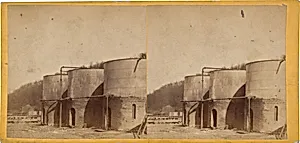
Oil Tanks, Clark & Sumner, Standard Petroleum Refinery, Pittsburg, Pennsylvania
c. 1865
Medium
stereoscopic albumen prints
Dimensions
image/sheet (each): 7.6 × 8 cm (3 × 3 1/8 in.) mount: 8 × 17.1 cm (3 1/8 × 6 3/4 in.)
Classification
Photograph
Department
CPH
Museum
National Gallery of Art, Washington, D.C.
Credit
Pepita Milmore Memorial Fund
Accession Number
2017.93.6
Rights
Public Domain
Art Historical Context
This striking stereoscopic photograph by Thomas H. Johnson captures the industrial landscape of the Clark & Sumner Standard Petroleum Refinery in Pittsburgh, Pennsylvania, around 1865. Created shortly after the first major oil discoveries in western Pennsylvania, the image documents the rapid rise of America’s petroleum industry during the Civil War era. Johnson’s careful framing of massive oil tanks highlights both the scale of these new structures and the transformation of the American landscape by emerging technology and commerce. The work is presented as a pair of albumen prints mounted for viewing in a stereoscope, a popular that created a vivid three-dimensional effect for nineteenth-century audiences. Albumen prints, for their fine detail and tonal range, were the dominant photographic medium of the time Johnson’s choice to record an industrial subject reflects photography’s expanding role beyond portraiture, as artists began using the camera to chronicle factories, railroads, and the built environment. Today the image offers a rare glimpse into the origins of the modern energy economy. Acquired by the National Gallery of Art through the Pepita Milmore Memorial Fund, it preserves a moment when photography itself was still a young technology, yet already proving essential for recording the dramatic changes reshaping the nation.
About the Artist
Thomas H. Johnson · 1860–1870
Thomas H. Johnson was an American artist active in the latter half of the nineteenth century. Working during a period of considerable vitality in American art — when landscape painting, genre scenes, and printmaking were all flourishing — Johnson contributed to a visual culture that was expanding rapidly alongside the nation itself. The specifics of Johnson's training are not fully documented, th...